Saturday, October 16, 2010

UPL Wrap-Up: Where I Went Wrong

The UPL baseball season wrapped up earlier this month. Here are the final standings:


I went back and looked at what the standings were during the All-Star break and there wasn't much movement for the most part. Although, that's not to say that the season didn't have a dramatic finish. On the final day Phatsnapper managed to sneak past Hats for Bats to take the crown. I don't think we've ever had that happen on the last day in UPL Baseball before. (One year we did have a tie, though.)

Congratulations to Rupert (Phatsnapper) on his championship season! And I also should point out that both Pauly (Hats for Bats) and CJ (JimmyDix) both had remarkable turnaround seasons. Pauly's team played well enough to take the crown, but it just wasn't meant to be.

After my 6th place finish, I'm left trying to pick up the pieces. Going into this season, I listed most of my strategy for this keeper league. But there was one 800-pound gorilla in the room that I didn't want to talk about. I might as well talk about that now.

If you look at the history of warfare, armies have a tendency to fight the "previous war." Basically, military planners most carefully study the past war, what went wrong and what went right - and more importantly, what they could have done better. And so what happens is that when a new war breaks out, a seemingly solid strategy is to see how your current environment is similar to a past environment, then apply what was learned from that experience in order to best perform in the current war. It's not a bad strategy. In fact, it's probably a necessary component to any great strategy. But if you rely too much on what would have been a seemingly perfect strategy for the previous war, you can end up in big trouble.

In the UPL, we get to keep 18 players from season to season. For a team at the top of the pack, this sounds like a great deal. But it's really a double-edged sword. Things can change quite a bit from season to season, and in a non-keeper format you can change your roster swiftly with the times. When you have to keep 18 players, it can sort of feel like you're stuck in a quagmire.

Granted, my team had plenty of talent heading into this season. And I made some blunders along the way. But if I look at my top 4 picks from 2009, three of them heading into 2010 wouldn't have rated worthy of top 4 picks in my book (Carlos Beltran, Aramis Ramirez, Manny Ramirez) due to their problems with missing significant playing time the previous season. If we had done a complete re-draft, I think there would have been many opportunities to upgrade my team.

But I can't complain. I knew the rules ahead of time and made my own bed. Here are my top three regrets for this season, and they all boil down to not being aggressive enough:
1) Not getting more value for the #3 pick (in essentially the 19th round). I drafted Octavio Dotel to address my closer situation, but in hindsight, there was more league-wide demand for Aroldis Chapman than I realized. I had assumed that after Jason Heyward and Stephen Strasburg, there weren't any rookies who people were willing to trade away value to get. But I think I was wrong there. Had I drafted Chapman (or just  traded away the pick pre-draft), I could have probably gotten something better than Dotel.
2) Not addressing shortstop. I went into the year hoping that Jason Bartlett would have a .390 OBP with 30 steals. That would have been nice. But it didn't happen, and my backup plans for SS didn't work out either. At one point I thought about trying to trade for Troy Tulowitzki, and maybe I should have. But I kept thinking that a viable option at SS would just fall into my lap. It never happened.
3) Not fixing my starting rotation sooner. Part of this is bad luck. I mean, my starting pitchers were absolutely brutal the first month of the season. It's impossible to predict something like that. However, I could have done a better job of holding pitchers out of the lineup and searching the waiver wire for better short-term, and possibly long-term, solutions.

My goal was to win the league again this year, but at the very least I wanted to finish on the podium. So a 6th place finish is disappointing. The past 5 or so years I've been bouncing between first and middle of the pack. I still have a long way to go if I'm to field a contender year in and year out. The Chairman (O.N. Thugs) has made a habit of this, and really, so has C-Lauff (IamJabrone).

It was a fun season. Looking ahead to next year, I'll have to refine my strategy a bit. But then again, that part never ends.

Thursday, October 14, 2010

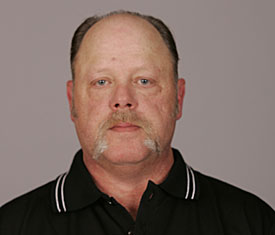
Jim Joyce Doesn't Know Why He's Home for Playoffs

With the 2010 MLB Playoffs now in full swing, only the league's best teams are still playing. The same is true of umpires. After a season-long evaluation, the top-rated umpires get to work the postseason. Unfortunately for Jim Joyce, the ump who blew an historic call earlier this year that cost Tigers' pitcher Armando Galarraga a perfect game, he won't be working these playoffs.

"Yeah, I was surprised that they didn't pick me," says Joyce, who enjoys Christmas lighting as a hobby and once was told that he might be related to Irish author James Joyce, according to
his MLB profile page. "Maybe there was some type of technical glitch or clerical oversight. When you really think about it, I had a helluva good season as an ump. I should be working these playoffs, not stuck at home like the Pittsburgh Pirates."

You might think that sitting at home and watching the MLB playoffs wouldn't be all that bad, but Joyce has found it maddening. "I've seen so many blown calls on TV, it's unbelievable," says Joyce. "Did you see what Paul Emmel did to
Jason Heyward in the 9th inning of Game 3 in the Braves-Giants series? Heyward took five pitches and instead of getting a walk, Emmel inexplicably called it a strikeout. The only way I'd say Emmel got that entire at-bat right would be if it were Opposite Day.

"And what was Hunter Wendelstedt thinking in Game 2 of Yanks-Twins when he didn't ring up
Lance Berkman in the 7th inning? I have no idea," says Joyce. "Or how about both Jim Wolf and Jerry Meals missing that check swing call on Michael Young in the Rays-Rangers series? I really felt bad for Joe Maddon, and believe me, when Maddon was giving Wolf the business, I was right there with him standing and screaming at my TV for both Wolf and Meals to get their heads out of their butts." 

Historic mistake: On June 2, 2010, Jim Joyce calls the runner safe even though he was obviously out. Perhaps the most infamous blown call in MLB history, Joyce single-handedly cost Armando Galarraga a perfect game. Could this be the reason he's not allowed to ump in this year's playoffs?

Despite Joyce's frustrations with not being in the playoffs and having to watch other umps consistently miss critical calls, he tries to keep things in perspective. "Being a major league baseball umpire is a tough job. It's not like being an NFL ref, where you can basically just make any call you want and then let the cameras bail you out on a replay."

When asked if his blown call that cost Armando Galarraga a once-in-a-lifetime chance at the record books might be why he didn't receive a high enough umpire rating, Joyce scoffs at the notion. "Look, that was an honest mistake, and I've apologized for ruining that kid's shot at baseball immortality," he explains. "Besides, Galarraga isn't even in these playoffs. And if he were, I'd be sure to give him a make-up call or two." 

Monday, October 11, 2010

Crocodile Tears: CryBabies League Wrap-Up

Back in April I blogged about the head-to-head CryBabies League that I had joined for fantasy baseball. At the time I was in 6th place and had been destroyed in Week 1 by the Mush Heads. Here's how I ended that post:
We'll see how things go. Right now I've circled Week 8 on the calendar. That's when I can get my revenge against the Mush Heads.

Sadly, things didn't turn out the way I had hoped. Yes, I somehow managed to get my team into first place for one magical week in late June or early July, but then the wheels fell off. A bunch of my players slumped and/or got hurt, including pitchers Stephen Strasburg, Ricky Nolasco, and Josh Johnson. But the worst part was that I Iost all four regular season matchups with the Mush Heads -- and he knocked me out for good in the first round of the playoffs. That means I was 0-for-5 on the season against the Mush Heads. That was brutal! 

If it's any consolation to me, the Mush Heads went on to win the championship. So congratulations are in order for Michael Hayes and his Mush Heads' season of glory. I also should give props to Steroid to Heaven, who won the regular season and finished runner-up in the tournament to the Mush Heads.


Despite my poor performance, it was still a fun season. I'll leave you with this video that perfectly illustrates how confident I was going into the season -- and then what happened when reality hit.

MLB Trivia: Pitching a Perfect Playoff Percentage

Lots of pitchers have gone undefeated in a single postseason. But only three pitchers have had a perfect 1.000 winning percentage in a single postseason while pitching 40 or more innings. Two of those pitchers were Orel Hershiser (1988) and Curt Schilling (2001). The third pitcher is still active. Who is he? (Hint: This player has pitched in this 2010 postseason for an AL team.)

Saturday, October 9, 2010

A Rare Baseball Feat, But Does Anyone Care?

Certain individual feats catch the imagination of MLB fans and journalists. Two that come to mind would be hitting for the cycle and throwing a no-hitter. These feats involve elegant number combinations and signify a player's excellent performance. They're also relatively rare. Since 1876, there have been 269 no-hitters; and since 1882, there have been 291 occurrences of hitting for the cycle. Doing the math, that's about two no-hitters and two cycles per year.

On a similar note, a couple years ago I posted a question for which I didn't have an answer:
When was the last time a player had two steals and two homers in the same game? 
It led to an interesting discussion, with Pauly finally tracking down a box score that showed Carlos Beltran accomplishing the feat in 2004. I was glad to know that it had been done, but I was still wondering how many times it had been done. So the mystery lingered.

From mid-2007 through 2009, I scoured box scores nearly every day during baseball season in hopes of noticing a player who accomplished the feat, but I found none. I also did an occasional web search to see if I could find answers in baseball history. I even tried asking Jayson Stark on Twitter. But other than Pauly's Carlos Beltran find, I was coming up empty. Just how rare is it for a batter to go for two homers and two steals in a single game? The answer was proving to be elusive.

Until now.

Thanks to Sean Holtz of Baseball Almanac, he searched his digital box score database which goes back nearly 100 years (early 19-teens) and has provided what might be the most complete answer available. According to Holtz, the feat has only been recorded 13 times. This means that hitting two homers and stealing two bases in a single game is about as rare as throwing a perfect game, which has been done 20 times.  

So who are these legends of the game that we've never heard about? Here's the list of 13 men known to have hit at least two homers and stolen at least two bases in one game:

#, Name, Date, Team, Pos
1. Jack Fournier, 1921-05-21,STL,1B
2. Don Kolloway*, 1941-06-28,CHW,2B
3. Tommie Agee, 1971-07-22,NYM, CF RF
4. Joe Morgan, 1973-04-15,CIN,2B
5. Howard Johnson,1987-07-11,NYM,3B
6. Dante Bichette, 1994-06-27,COL,RF
7. Kirk Gibson, 1995-05-28,DET,DH
8. Gary Sheffield, 1995-09-18,FLA,LF
9. Chipper Jones, 1999-09-05,ATL,3B
10. Carlos Beltran, 2004-08-27,HOU,CF
11. Rafael Furcal, 2005-04-15,ATL,SS
12. Chris Duffy, 2006-09-07,PIT,CF
13. Ryan Spilborghs, 2009-05-02,COL,CF LF

*All the people on this list hit exactly two homers and stole exactly two bases in their games, except one. Don Kolloway hit two jacks and was an absolute jackrabbit on the bases with four steals.

Now, in fairness, our data for perfect games goes back further than our data for these 2-homer/2-steal games. And it appears that going for two homers and two steals in a game has become more common since 1994. This could be for a variety of reasons. But still, since 1994, only eight guys have gone 2/2 in a game and only seven guys have thrown a perfect game. I'm willing to concede that throwing a perfect game is a more impressive feat, but hitting two homers and stealing two bases in a game is much more difficult than hitting for the cycle.

So why doesn't going 2/2 in a game get more media attention? I obviously missed Ryan Spilborgh's 2/2 in 2009, even though I had been trying to keep an eye out for it. Going back and reading that game's recap is actually funny because, aside from the box score, there is no mention of the special achievement. The article simply says, "Spilborghs homered twice and drove in three runs."

Maybe what we need to do is create a name for going 2/2 in a game. After all, throwing a "no-hitter" and hitting for "the cycle" sound cool and give symbolic meaning to these special feats. Perhaps we could name going 1/1 in a game as "[Blank]," and then 2/2 would just be "Double [Blank]." Any suggestions for a name out there? You never know, if we toss out five or six ideas, one of them might stick. One day we could hear Joe Morgan on Sunday Night Baseball say, "Hanley Ramirez just got a [Blank] with that steal. Now a [Blank] is what they call getting a homer and a steal in the same game. Back in my day, one time I got a Double [Blank]. That's two homers and two steals in a game."

But I digress. The important thing is that at least now we know. So the next time a player on your favorite team comes up to bat in the top of the 9th with two homers and a 12-3 lead, rather than rooting for him to hit that third homer, which has been done hundreds of times, you might want to instead root for him to single and steal second and third. Then he'd join a much more exclusive club.

Tuesday, October 5, 2010

The 2010 Razzballies

If you haven't checked out the year-end awards over at Razzball yet, well, you should. Here's a taste:
Player You Traded For That You Most Regretted – Did Pablo Sandoval really just hit .250 on my team with 7 extra base hits in three months?
Ouch. That one struck a little too close to home.

Monday, October 4, 2010

MLB Trivia: Managing Wins

Bobby Cox plans to retire at the end of this season. He currently has the highest winning percentage (.556) among active MLB managers. Who is second on that list? (Hint: This manager led his team to a World Series championship within the past decade.)

Sunday, October 3, 2010

Is Mike Quade's Name Sexy Enough to Be Next Cubs Manager?

Mike Quade feels that he's done everything possible to become the next manager of the Chicago Cubs. He's managed 17 seasons in the minors, earned Manager of the Year honors twice, won multiple championships, coached for two major league teams, spent the past four seasons as a coach for the very Cubs he hopes to manage, had possibly the best start in Cubs history for an interim manager going 24-13, and has players saying they want him to be their manager in 2011. It sure sounds like an impressive resume, but one thing might be missing. Does Mike Quade (pronounced "KWAH-dee") have a sexy enough name to become the next Cubs manager?

"Does the sexiness of a name factor into our thought process? Of course it does," admits Jim Hendry, Cubs general manager. "How else do you explain us giving $136 million to Alfonso Soriano?"

So which sexy names might be on the Cubs radar? It's no secret that Cub fans carry a torch for a name like Joe Girardi, who is a former Cub, won a recent World Series, and has the Italian thing going on. Although, the name that really pushes all the right buttons for Cubbie Nation is that of Ryne Sandberg, a Hall of Fame Cub and the most lovable of the Lovable Losers.

"Of all the names being considered for the Cubs managerial opening, I realize that mine isn't the sexiest," says Quade. "But you have to remember, my birth name was Gregory Quade. So I'm trying. You at least have to admit that Mike Quade sounds better than Gregory Quade."

However, if Quade hears that his name is the only thing keeping him from his dream job, he's willing to compromise. "If it came down to it, yes, I'd change my name. My wife has already suggested that I change it to the most successful name in managing today: Bobby Cox. She also just likes the idea of waking up every morning in the arms of a Bobby Cox."

It's hard to know what the future will hold, but two names that Quade doesn't have to worry about would be the previous two Cubs managers: Lou Piniella and Dusty Baker. Quade adds, "As far as I'm concerned, the name 'Dusty Baker' sounds like a health code violation."